I Once Fed Not Myself, but God
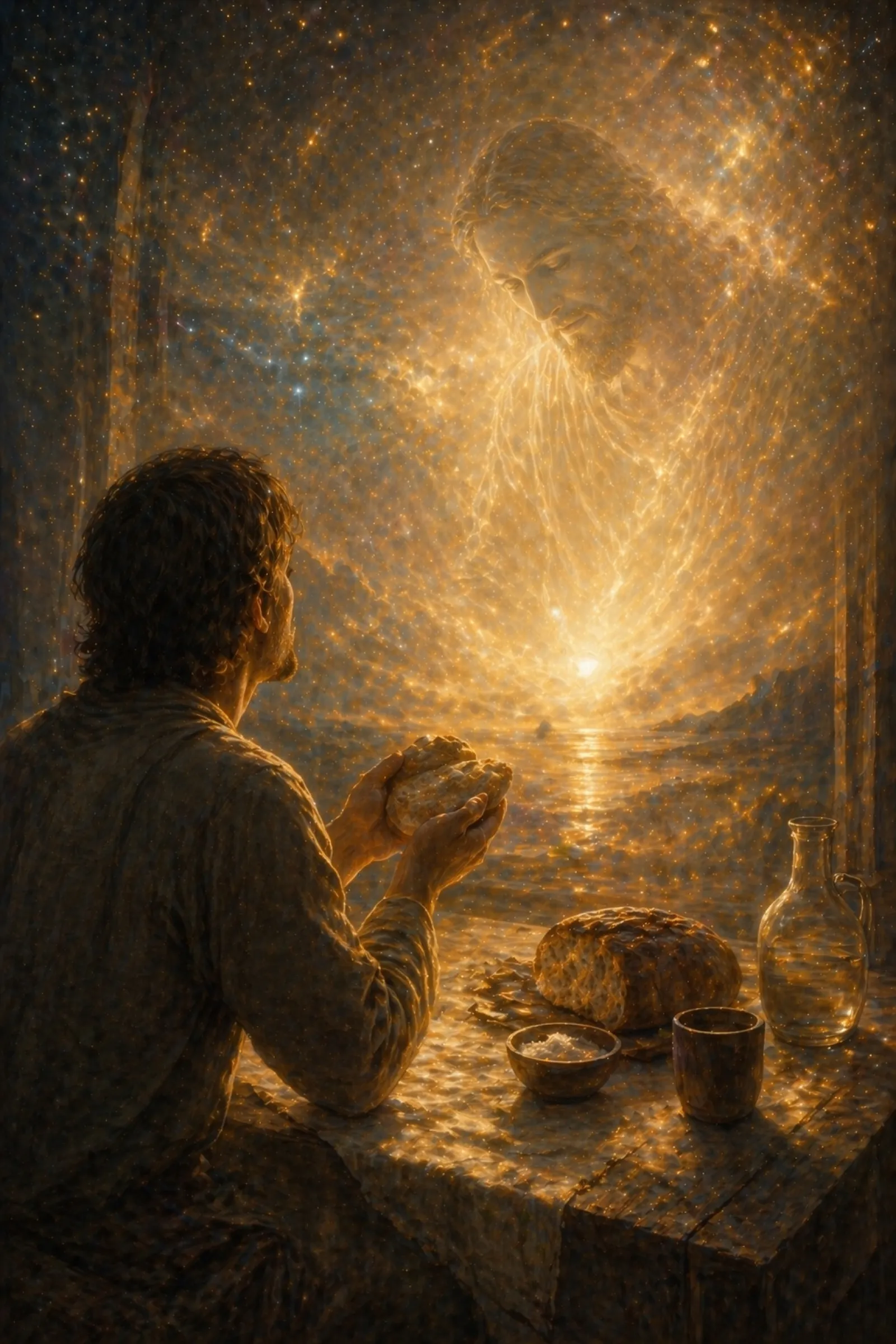
I once fed not myself, but God.
Not in a church — just on a quiet day.
There lay the bread, the salt, and so much light
in one plain moment that became an altar.
And suddenly it opened: not the body only eats.
Not the mouth alone partakes of this whole world.
All Being, boldly, through the human gaze
looks on the fruit, the bread, the warm soft cheese…
God is one. But to become a touch,
to enter taste, and breath, and heat, and crunch,
He became you, He became my own attention,
He is placed within the human as within a vessel.
Not so that He might hide Himself behind us,
not so that He might own us as His own, —
but so that He might touch the leaves with fingers, lips,
and know eternity inside a drop of honey.
He looks through us. He listens. And He tastes.
Through us He finds Himself again, again.
And the human does not merely mirror back —
he gives to God experience, flesh, and blood.
But people, even at the table, at the bread,
where life could very nearly turn to holy,
are filled instead with someone’s roaring sky,
with someone else’s thought, the newsfeed’s stream.
They chew and at that instant they consume
not food alone — but images and smoke.
And so they cut the taste of life to pieces,
not letting it grow wholly, fully, live.
And in that instant it is as if they steal
from God the world that came to Him through the mouth:
they do not eat the bread — they read the bulletin,
they do not drink the wine — but someone’s dead, cold code.
And yet in the breaking of the bread — the secret of the meeting.
And yet in the wine — no symbol, but an answer:
that God is not somewhere outside, not endlessly
deferred to thought, to doctrine, to a shape.
He is here — in the taste of the warm crust,
in the thick wine that has just touched the throat,
in how the hand reaches from far away
and gives the world back to its radiance…
When you eat — do not hurry the moment.
Do not drown it out with someone else’s line.
Let God taste in you His own creation,
let Him be not a thought — but berry, flour.
Let bread be broken, like a day in palms.
Let light pour into ordinary drink.
And God, the one, in every smallest tone
will know the world, while tasting being itself.
Then eating turns into no longer food,
but a way of recognizing His own self.
And the human is no longer merely searching —
he is seen by God, and eats through God, in love.
And in this lies the meaning of each touch,
not of the bread alone, the cup, the board:
God enters the world not by creation’s thunder,
but in the way a cherry ripens in August’s heat.
He recognizes Himself not from on high alone,
not only in the abyss of stars and silence, —
but in the way you breathe above your cup,
in how the salt crunches on the fresh-cut slice of day.
He did not come to creation out of hunger,
not out of need for any fruit or wine.
He longed not after knowledge — but for burning,
not for the schema of the world — the world’s own depth.
And so He became gaze, and ear, and skin,
became the tongue that senses honey’s sweetness,
became a human, only to exist, O God,
not as the One who knows — the One who comes to know.
But man, forgetting all the secret of the taste,
hurries to fill up every single crack:
while chewing — takes into himself the refuse
of others’ speeches, passions, racing speeds.
A plain fullness frightens him to death,
where one could be without a feed or screen,
where bread is bread, and water is pure cleanness,
and silence does not seem to be a flaw.
And so behind the meal — a new replacement:
no table, but a dump of facts and phrases.
As if a life is not worth being deathless,
until it has been named by someone else.
As if for God the world were not enough,
and one must salt it down from above with noise,
as if the taste, born in the feast’s deep places,
could not live on without a running comment.
But taste does not love bustle, does not love noise.
Taste is the entrance to the wordless “now,”
where God in you does not reflect, does not deliberate,
but simply IS, and tries the world through us.
And if you, even for a moment, free of static,
take in your palms the bread, like the first fruit,
you’ll suddenly grasp: you are not the only one fed —
God Himself in you both eats and drinks the world.
And in this there is no pride, no role,
no chosen ones, no outward height at all.
There is only life, arrived to the point of pain
in the plain miracle of bread and water.
There is only God, one in all and everywhere,
but become a multitude of touching hands,
to enter through us into His own miracle,
into His own creation, color, love, and fear.
To look through us upon the snow and flame,
to embrace through us, to drink, to draw a breath,
to, through us, unnamed by any words,
within Himself continue on this path.
And so it matters so much to be alive
not in our thoughts alone, our knowledge of Him,
but here, where bread is still called only bread
and where the wine has not yet turned to dream.
Here man is not a slave and not a blunder,
not dust, by chance picked up for a short term.
He is that living attempt of God Himself
to enter the taste of all that God has made.
He is God’s way to touch the world with lips.
He is the world’s way to grow dear to God.
And if we’ll stay, even a moment, with ourselves,
then maybe God, too, will abide with us.
And maybe, at the very quietest of meals,
where there are no speeches, only light and bread,
the Lord will know Himself not by the image,
but by the way a human has gone blind
from simpleness, from fullness, from the wonder,
from that same love that in a crumb of being
speaks suddenly, in silence, everywhere:
I eat, I drink, I’m here, I AM, and this is I.